
Keeney Manufacturing Company 1/4 turn defective leaking ball valve

Messages
152
Reaction score
15
Points
18
Location
Berkeley, CA
I've got a 1/4 turn ball valve that's leaking. Looking at it, the shaft appears to be plastic and its dripping pretty good.
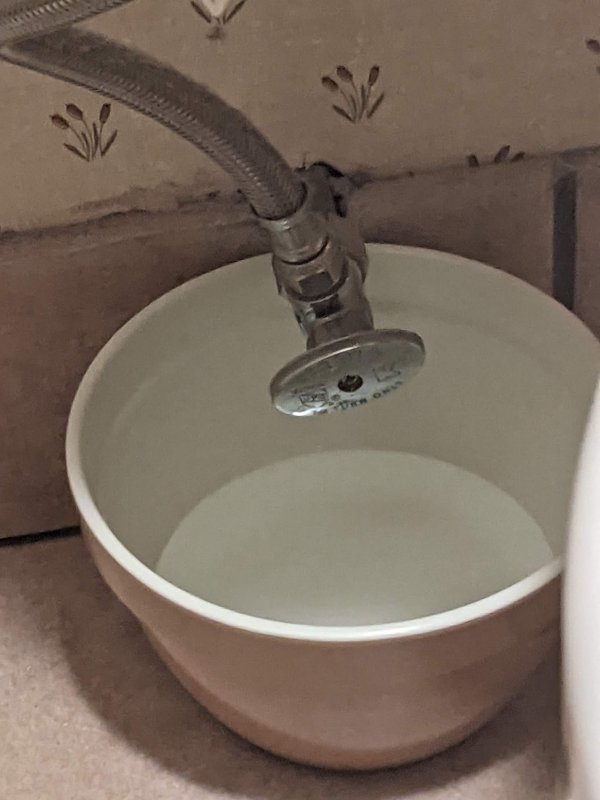
PXL_20211224_033827085.jpg


Going to the local ACE and checking Lowes online, they sell what looks like the same valve.
Is Keeney a generally good brand, or should I hold out for something higher quality?

I read a rumor that Keeney built but did not recall a metric buttload of bad valves a few years back. Does anyone have an authoritative story?
 
I'm not aware of a fix for that. Replacement works though. What kind of pipe is coming from the wall?
If it's copper, a new compression shutoff is a good idea. Either a sleeve puller to remove the back nut, or there may be room to cut and install the new shutoff.
 
Last edited:
Cheap junk if it leaks throw it away. If you have one that doesn't leak don't worry about it but I don't like those
 
Keeney is a retail store brand. Typically all 1/4 turn angle stops from retail stores have plastic balls. For a short time that was what we got at our supply stores as a lead free option, but now we have metallic, likely stainless balls.
 
The Brass Craft angle stops sold at HD are of much better quality, and at a competitive price, had issue with a stop failing quickly because of the water temp in a commercial kitchen (160°F), the Brass Craft valve has held up for years, have found that Keeney products quality is not very high, & the extra hassle of replacing garbage is not worth it. "Buy well, buy once".

To anyone wondering why such a high water temp, a commercial low temp dish machine requires a minimum of 120°F water to be compliant, in order for the dishes to be cleaned & sanitized even with the chemicals, staff cannot use towels to dry the dishes as regs require them to be air dried, to keep the temp at around 140°F so they dry quickly that temp is required to stay compliant and takes about 2 minuets for each load to wash.

A commercial "low temp" dishmachine requires 120° water & uses chemicals to sanitize the dishes, a "high temp" machine requires 180°F water & has a booster to raise the water temp, the hotter water is more likely to cause scalding, so the low temp machines are preferred.
 
Back
Top