Fine thread adapter for hose bib with integral vacuum breaker

DAVID HERTZEL

New Member
Messages
8
Reaction score
0
Points
1
Location
San Diego, CA
I found the pictured hose bib on the back of a stand-alone garage built shortly before we purchased our property in 2017. I've lived with it, but finally decided to swap it our for the correct fixture so I could add a pressure regulator and stop bursting the leader hose to the timer. I discovered that the existing hose bib is attached to an adapter with a fine thread that won't accept a standard hose bib, and after doing some research and reading (including on this forum), I figured the existing hose bib must have an integral vacuum breaker and has the fine thread on the inlet side that vacuum breakers utilize. I figured the easiest thing to do would be to find a hose bib with the same fine thread on the inlet side, but Home Depot doesn't have anything, and I can't find anything online that indicates the necessary fine thread, except adapters that have a hose thread on the outlet side. I'm assuming since the existing inappropriate hose bib has the fine thread, an appropriate hose bib with fine thread must exist? I can't find any indication of a manufacturer on the existing hose bib. I suppose I could take off the adapter, but with arthritis and multiple trigger fingers, that will have to wait for my gardener to come back. Any suggestions? Much thanks.

20210531_151555.jpg
 
You opened the hose bibb and left the base of the bibb on the pipe. Being California, is looks like a galvanized iron pipe that is barley sticking past the stucco wall. You'll need to remove the entire bibb which is all brass. It may be tough to do since the iron pipe could be frozen to the brass. As you turn the bibb, the iron pipe might unthread from inside the wall which will be an elbow. If it does, a new length of pipe can be inserted into the buried elbow. Besure to use pipe dope or tape. To do it first thread on the pipe to the new bibb, then insert it into the buried elbow.

Removing all of the brass and you'll have a standard 1/2" or 3/4" NPT (14 threads per inch). The hose bibb will read FIP for "female iron pipe".

hose bib.jpg
 
Last edited:
You opened the hose bibb and left the base of the bibb on the pipe. Being California, is looks like a galvanized iron pipe that is barley sticking past the stucco wall. You'll need to remove the entire bibb which is all brass. It may be tough to do since the iron pipe could be frozen to the brass. As you turn the bibb, the iron pipe might unthread from inside the wall which will be an elbow. If it does some out a new length of pipe can be inserted into the buried elbow. Besure to use pipe dope or tape. To do it first thread on the pipe to the new bibb, then insert it into the buried elbow.

Removing all of the brass and you'll have a standard 1/2" or 3/4" NPT (14 threads per inch). The hose bibb will read FIP for "female iron pipe".

Click on the image for full size:
View attachment 74177

Thanks, I was afraid that would be the answer. Just to be sure, you aren't aware of a replacement hose bib that would work with fine thread base?
 
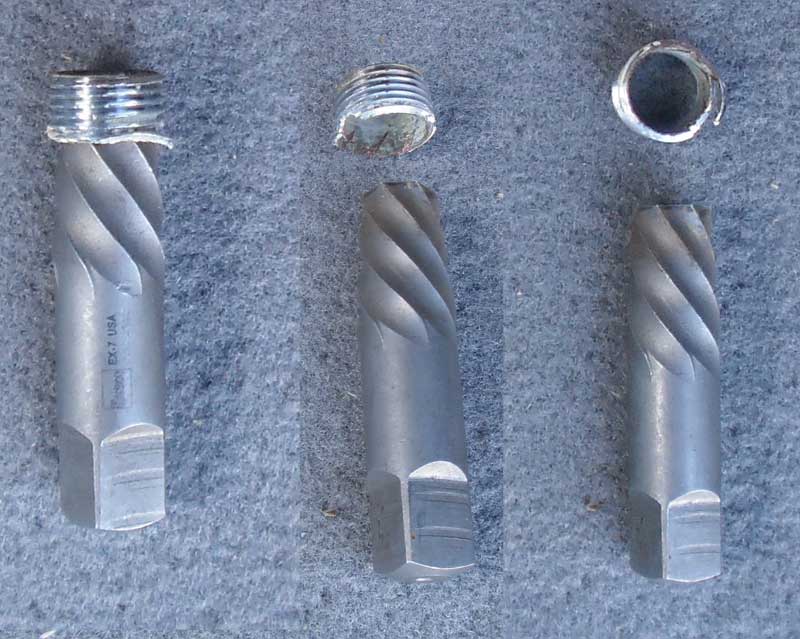
By unscrewing the valve at the fine threads might be able to get a internal pipe wrench through the brass part into the galvanize nipple to hold it to unscrew the brass.

nipple-extractor-terrylove-02.jpg


pipe_extractor.jpg
 
Last edited by a moderator:
By unscrewing the valve at the fine threads might be able to get a internal pipe wrench through the brass part into the galvanize nipple to hold it to unscrew the brass.

Looked it up and I understand! Is there a special tool to use on the brass so that I don't scrape my knuckles on the stucco (besides gloves)?
 
Looked it up and I understand! Is there a special tool to use on the brass so that I don't scrape my knuckles on the stucco (besides gloves)?
Extension between the socket wrench and socket, or use a long socket?
husky-socket-extensions-h2dext3-64_100.jpg
 
Last edited:
If the pressure is too high to the hose bib, I then suspect the pressure will be too high to all of the home plumbing.

The pressure to a home should be 80 psi or less. Most municipal supply pressure is 60 psi. Instead of attempting to alter the garden hose faucet to add a PRV, it may be much simpler and appropriate to install a PRV in the incoming supply line to the home.

I suspect the hose bib shown with the removable handle may be manufactured by Zurn.

I would shut water off at the house and see if water still on to the detached garage the water might tee off to garage before entering house and house might already have a regulator
 
Wow, so much good information! My pressure issue is that the leader hose is running to a timer that's only used 1o minutes/day to supply drip irrigation. Not sure that can handle even 60 psi. The hose bib is probably part of the irrigation water, which tees off right after the main shutoff valve, and thousands of feet of irrigation pipe is all below the level of the shutoff valve, and that's before you get to the garage, about 30 ft lower in elevation. 17 irrigation zones, and separate systems for the lemon orchard and vineyard (my second wife has money), don't really want to mess with the overall pressure.

Don't see any hose bibs on Zurn's website. Gotta go buy some new tools! Thanks everyone.
 
Back
Top