Hello. This is sandwiched in the walls between tiled shower and closet with finished shelving in a finished walk out basement and I don't want to tear into the house to replace it. It leaks under hose pressure from the handle. I have a few questions. Is that split in the nut from the factory or is it a crack? If I unscrew the silver portion, what chance will I have of being able to repair it? This is original from 1987 and I wouldn't begin to know how to get parts or even who the manufacturer is? I don't want to tear into it to find my only option is complete replacement. Any help is very welcome. Thanks!

You are using an out of date browser. It may not display this or other websites correctly.
You should upgrade or use an alternative browser.
You should upgrade or use an alternative browser.
Old frost free bib question?
- Thread starter jess58
- Start date
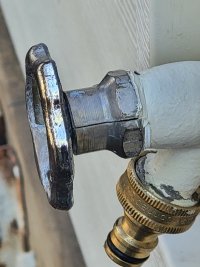
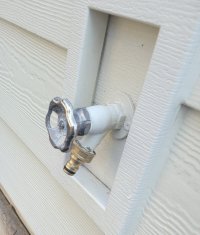
Reading my own post, a few things look hazy. By repair it, I mean the leaking faucet. Is it just washers in there that would need replacement?
And I'm really confused why that line or crack or whatever it is would be on what looks to me like a cast piece? I'm happy to even hear opinions. Thanks
And I'm really confused why that line or crack or whatever it is would be on what looks to me like a cast piece? I'm happy to even hear opinions. Thanks

Sponsor
Paid Advertisement

Thank you. That "crack" is my biggest concern and it's the thing that keeps me from taking than nut off and seeing what's what. It looks just like a can of worms...lol. If I knew what it was, I could buy the part. But it has no serial number or company identification. I was hoping someone could tell me the company and model number.
cdherman
Member
Can you shut off the faucet independent of the rest of the house from the inside? Or get at the line and cut it and install a ball valve on the inside? (Sharkbite and minimal clearance pipe cutters are wonderful things) A large part of the "risk" you are taking in trying to repair that valve is just how much of the rest of the house will be affected if things go wrong. If you can isolate that valve, you can spends days and weeks trying to find repair parts. But if it cannot be isolated, probably better not mess with it. Leave it shut off, remove the handle, and find a new better location for a new sill cock.
cdherman
Member
That a pretty old frost free sill cock by the way. Before backflow preventers were required. A shot from the front might help. But unless its a known name brand, parts are hit/miss. But often plumbing houses or even a decent Lowes (they vary, ones in old parts of town have a wall of seals and stuff) my have a part you can visually verify as correct.

Fitter30
Well-Known Member
Crack is on casting seam? Try a couple stainless hose clamps. On around the nut the other the body after sanding the areas to put a coat of expoxy over the clamps.Wouldn't tighten the clamps to close the gap all the way.
Thank you both for your insight. I became frustrated with no responses and being unable to locate the manufacturer or replacement part, I opted to replace the thing and do the necessary plumbing involved. So I went into the closet and removed the drywall in the location I'd calculated it to be. I found out that the closet back wall encompasses the closet on one side and the tiled shower on the other. This is a 2x4 stemwall. Here's the curious part. I could not locate the silcock, anywhere. It does not penetrate the wall at all. The closet and shower back up to the back framed wall. So I can not find any plumbing feeding anything and have no way to turn off the bib individually. This is very basic 1/2" copper with no shut offs or manifolds.
This is in the heart of the midwest where -20 degree days in winter come with some frequency. It has me completely baffled? Could this not be a frost free at all? Do they make frost frees so short they don't penetrate a 6" wall? I'm just completely at a loss at this point. But I do know one thing, this thing doesn't penetrate the wall and whatever pipe is feeding it, it must be in that wall as well. The home was built in 1987 and I would say that silcock is totally original and was probably quite accessible prior to the basement build out. I can't believe these guys just buried everything. As before, any ideas are welcome. Because I have literally run out.
This is in the heart of the midwest where -20 degree days in winter come with some frequency. It has me completely baffled? Could this not be a frost free at all? Do they make frost frees so short they don't penetrate a 6" wall? I'm just completely at a loss at this point. But I do know one thing, this thing doesn't penetrate the wall and whatever pipe is feeding it, it must be in that wall as well. The home was built in 1987 and I would say that silcock is totally original and was probably quite accessible prior to the basement build out. I can't believe these guys just buried everything. As before, any ideas are welcome. Because I have literally run out.
Last edited:
I don't think so.Do they make frost frees so short they don't penetrate a 6" wall?
I suspect that in the winter they turned off the supply to that valve, and opened the valve up to keep freezing from breaking pipe.
I would agree with you accept that there are no provisions to do that. No ball valves, nothing.I don't think so.
I suspect that in the winter they turned off the supply to that valve, and opened the valve up to keep freezing from breaking pipe.
Can you ask the former homeowner?I would agree with you accept that there are no provisions to do that. No ball valves, nothing.
Unfortunately, they seem to be blissfully ignorant about everything. She had a "cousin" who did all the "work" on the house. All his handiwork makes me wish she didn''t have a cousin. I've owned the house for 10 years and am constantly astonished at all of the cousins efforts.Can you ask the former homeowner?
Well.....looks like I'm in the crappy position of having to take a chance and spin that packing nut off. Any opinions on what size it might be and whether it's fine or Coarse Thread? I don't want to pull it off if I can't plug this mess if it all goes wrong.
No drop ceiling? Shelves are not removable to let you get to an access panel?This is sandwiched in the walls between tiled shower and closet with finished shelving in a finished walk out basement and I don't want to tear into the house to replace it.
Thanks for the reply. Above, are kitchen counters. I have already removed shelves, cut into drywall and found nothing. There is no ready access. The basement build-out guys buried everything behind drywall and tile and showers and shelves. I measured precisely where the bib enters the home and it literally isn't there. It leads me to believe it's a very short frost free and then runs up the wall and through the joists to where everything terminates in the mechanical room. Without ripping and tearing out tons of ceiling drywall, there's no way to know. I'm looking for the easiest and least invasive method. The outside is brand new hardie. I'm obviously not wanting to mess with that. If I had known, when it was off I would have remedied this problem then. I have yanked out a ton of drywall and replaced plenty of these things over the years. This is the first time I've come across the Houdini model.
Similar threads

- Replies
- 3
- Views
- 1K


- Replies
- 8
- Views
- 2K

- Replies
- 2
- Views
- 3K
- Replies
- 0
- Views
- 1K