Mysterious Water Heater Problem

Scottk

New Member
Messages
15
Reaction score
0
Points
1
Location
South Carolina
Sometime over the last few months, my water heater stopped producing nearly as much hot water as it used to. I used to be able to fill up my tub with water so hot, I had to muster my strength and sloooowly inch my way in.

Now when my tub is full, it's just a smidge above room temp. Luke warm. Even with the thermostats sets at 140.

Maintenance replaced the thermostats because the heating elements tested good. It didn't work, so they replaced the elements anyway. Upon removal, we noticed the elements were very heavily calcified, so we figured we had solved the mystery.

Turns out that wasn't the issue either.

Not the thermostats. Not the elements. What else could be causing a lack of hot water?

Any insights would be much appreciated. The maintenance guys and I are stumped.
 
Is the house on a slab? If so, are the pipes running underneath it? One (of many) possibilities is an under slab leak. When nothing is turned on, take a look at your water meter and see if it shows water use.
 
Is the house on a slab? If so, are the pipes running underneath it? One (of many) possibilities is an under slab leak. When nothing is turned on, take a look at your water meter and see if it shows water use.

Thanks for the response.

I'm in an apartment, on the 2nd floor. Not even sure if I have a water meter. But I'll check.

You said "one (of many) possibilities." What are some of the other potential culprits?

Cheers
 
Some valves can develop internal leaks between the hot and cold supplies (cross-over). When that happens, the water will take the path of least resistance, and that may mean more cold making its way along the normal hot water path. One way to try to isolate that is to shut the cold water off to all faucets. Check if the tub can get its normal hot water. If it can, open one cold shut off at a time and see which one causes problems (this is only needed for single handle faucets).

If that doesn't isolate the problem, we'll try to come up with something else to try. If it does, the cartridge of the offending faucet needs to be changed.

Thank ya sir. Much appreciated. I'll give it a shot tomorrow and see what happens.
 
Some valves can develop internal leaks between the hot and cold supplies (cross-over). When that happens, the water will take the path of least resistance, and that may mean more cold making its way along the normal hot water path. One way to try to isolate that is to shut the cold water off to all faucets. Check if the tub can get its normal hot water. If it can, open one cold shut off at a time and see which one causes problems (this is only needed for single handle faucets).

If that doesn't isolate the problem, we'll try to come up with something else to try. If it does, the cartridge of the offending faucet needs to be changed.

No dice on this. Shutting off all cold water didn't improve the hot water situation. Any other ideas? Thanks.
 
Its rare the thermostat will fail. how old is the tank? id break out the volt meter and make sure your getting 240v to the tank.

I'll have the maintenance guys check it out next time they're over. I know it's at least getting some power, because I do still get hot water. But it only lasts for about 5 minutes.
 
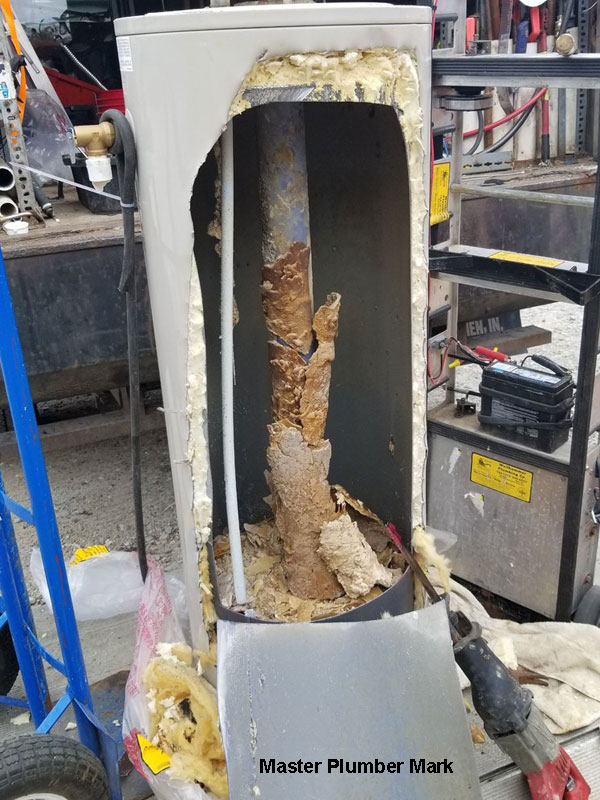
What is the water like where you are at? Sometimes they can get limed up and no longer have the volume of water that they had when new.
In some places that happens in seven years. How old is the water heater?

water-heater-lime-2.jpg
 
Last edited:
How hot is the water at the bathroom sink and kitchen. Is your tub-shower valve a Moen? If it is it’s the cartridge. The anti scalding device inside the valve will jam. I had one that did it, one at my son’s house and a few friend’s homes. Moen changed something and cartridges made around 2005 that had the problem.
 
What is the water like where you are at? Sometimes they can get limed up and no longer have the volume of water that they had when new.
In some places that happens in seven years. How old is the water heater?

water-heater-lime-2.jpg
Good god lol that is disgusting. The water at my place is pretty horrendous. I'm in South Carolina. When they replaced the heating elements, they were completely calcified over. That said, this apartment complex is only 3 or 4 years old. Could that much sediment build up that quickly?
 
Last edited:
It sounds like the lower element has burned out. That is the one that works 95% of the time and fills the tank with hot water.

Yeah that's what we thought too. They replaced both elements just to be safe, but the issue persists :/
 
Not sure if this is relevant information or not. But today I decided to see exactly how much hot water I'm getting. I ran the tub, full hot, and every fifth gallon I filled up a cup and took the water temp.

Here are the temperatures of every 5th gallon for a 38 gallon water heater with thermostats set to 130º.

1st gallon - 120º
5th gallon - 120º
10th gallon - 120º
15th gallon - 118º
20th gallon - 103º
25th gallon - 90º
30th gallon - 83º
35th gallon - 80º

So not only does the water never actually reach 130 degrees, but it starts to decline rapidly after about 8 minutes.
 
How hot is the water at the bathroom sink and kitchen. Is your tub-shower valve a Moen? If it is it’s the cartridge. The anti scalding device inside the valve will jam. I had one that did it, one at my son’s house and a few friend’s homes. Moen changed something and cartridges made around 2005 that had the problem.

I'll check this out and let you know. My faucet is a Peerless.
 
The first place to look is to see if the dip-tube is corroding away and getting shorter, which will have this sort of symptom. A shortened dip-tube inserts the water at mid-level in the tank rather than at the bottom- it'll start out nice and hot but the temperature fades fast as more volume is drawn.
 
The first place to look is to see if the dip-tube is corroding away and getting shorter, which will have this sort of symptom. A shortened dip-tube inserts the water at mid-level in the tank rather than at the bottom- it'll start out nice and hot but the temperature fades fast as more volume is drawn.

Thanks, I'll run that by the maintenance guys. They're all pretty stumped. I have a funny feeling they might just replace the whole tank at this point lol.
 
So not only does the water never actually reach 130 degrees, but it starts to decline rapidly after about 8 minutes.
If the WH is installed with the required options, while the internal temperature may get above 120-degrees, it should NEVER get above that at the tub...a tempering valve is required to limit the outlet temperature if you run the thing above 120-degrees, and where I live, it's required, regardless of the temperature you set your WH.

I'm not saying you have a tempering valve installed, but you should if you're going to crank up the thermostat. What that does, though, is extend the amount of 120-degree water you get on the outlet because it is mixing in some cold to drop it to the limit of 120-degrees until the tank cools off.

While anything's possible, bad dip tubes haven't been an issue lately. THere was a run of bad ones, but that was before your unit went up by quite awhile. If the tube is bad, the incoming cold mixes with the hot rather than being directed to the bottom. I'd think you'd notice it sooner than you did, but it's possible, depending on where it was broken or leaking from.

Ok, tempering valve explains why it peaked at 120. I cranked it to 130 assuming I could compensate for the issue with a hotter setting. Shows what I know about plumbing.

So if it's not the elements or thermostats (both replaced a couple days ago), and you're thinking it's not the dip tube. And assuming my tank hasn't built up 15 gallons' worth of sediment in the last 4 years. What's left?
 
It more and more sounds like cold water is mixing with the hot water after the water heater. If you have a infrared thermometer, check the temp at the water heater. You probably have CPVC so point it right below the connection where you see the metal. Or at the first faucet from the water heater. You need to get an actual reading right out of the water heater. Checking it at the tub is not enough.

Another trick is turn off the cold water at very faucet including the washer and try it at the tub. You probably cannot turn off the cold water at the tub. If you can do it the better. This is to eliminate any possibility of cross mixing. If the water still gets luke warm check the temp at the water heater. If you’re good you can tell how hot the water is by placing your hand on the pipe. If the water is hot as expected with all the cold water valves closed there is cross mixing going on somewhere. Then test again after opening one cold water valve at a time. If the temp is still low with all cold water valves closed then is still,points to the water heater or the tub faucet valve if you cannot turn off the cold water.

You must eliminate and isolate the problem. Not just replacing parts to eliminate.

upload_2019-2-17_15-30-19.jpeg
 
Last edited:
Back
Top