Deposits on Outside of Tank

SAS

Member
Messages
341
Reaction score
16
Points
18
Location
Connecticut
I just noticed two vertical lines of deposits on the outside of my gas hot water heater. One is under the pressure relief valve and the other is under the "Space Heating Outlet". What is causing this and is there something I should do about it? So far I haven't seen any evidence of a leak beyond these two streaks on the side of the tank.


waterheater2.jpg


waterheater1.jpg
 
Can take tp or paper towel stuff it in around each hole check them in a couple of days they will be deformed if they get wet. Heater over 10 years might want to budget for a new heater.
 
Can take tp or paper towel stuff it in around each hole check them in a couple of days they will be deformed if they get wet. Heater over 10 years might want to budget for a new heater.
I cleaned the first few inches under each hole so that I can tell if it is leaking again. The heater is only 5 years old, so I am hoping that it's still got some life left in it..
 
I cleaned the first few inches under each hole so that I can tell if it is leaking again. The heater is only 5 years old, so I am hoping that it's still got some life left in it..\

You might be wise to warranty out the heater before the 6 year warranty is over.. It appears to be a
small leak that is weeping for now... Wait until the 6 years is up and it will probably really take off
 
You might be wise to warranty out the heater before the 6 year warranty is over.. It appears to be a
small leak that is weeping for now... Wait until the 6 years is up and it will probably really take off
Thanks for the advice. I didn't realize that the warranty was 6 years, but I plugged the serial number into the Bradford White website, and the warranty does extend until next summer. So now I have the following dilemma: since this only happened once, and it has not shown any signs of leaking since that one time, do I try to have it fixed under warranty? Do you know how that process works? Is it like a mattress or tire warranty where they prorate the amount based upon an assumed life of X years? It seems as if I need to have a licensed plumber assess the problem and file the warranty with the company, and I'm not sure how much that would cost me out of pocket. And if it only happened once, what circumstance could have caused it?

 
I wonder if that was due to a big rain, and water came down the flue.
 
Thanks for the advice. I didn't realize that the warranty was 6 years, but I plugged the serial number into the Bradford White website, and the warranty does extend until next summer. So now I have the following dilemma: since this only happened once, and it has not shown any signs of leaking since that one time, do I try to have it fixed under warranty? Do you know how that process works? Is it like a mattress or tire warranty where they prorate the amount based upon an assumed life of X years? It seems as if I need to have a licensed plumber assess the problem and file the warranty with the company, and I'm not sure how much that would cost me out of pocket. And if it only happened once, what circumstance could have caused it?

you have to get a plumber to do this for you....

if it appears to have leaked and then stopped they are pretty forgiving
about it and really dont analyze the situation...
Its more about getting a cost estimate to do the change out..from a local plumber..
 
I just noticed two vertical lines of deposits on the outside of my gas hot water heater. One is under the pressure relief valve and the other is under the "Space Heating Outlet". What is causing this and is there something I should do about it? So far I haven't seen any evidence of a leak beyond these two streaks on the side of the tank.


View attachment 105813

View attachment 105814
Check the fittings on top of the water heater, water connections. Quite often they will leak at the top, water flex or union, depending on where you are and local codes. A leak on the top will seap down and leave these types of deposits.
 
Check the fittings on top of the water heater, water connections. Quite often they will leak at the top, water flex or union, depending on where you are and local codes. A leak on the top will seap down and leave these types of deposits.
No, I don't think that could be the cause. There are no signs of water leaks above the two outlets in the photo. If the water were leaking from the connections on top of the tank, it would have left an indication of its flow both on top ot the heater and also on the sides above the two outlets.
 
No, I don't think that could be the cause. There are no signs of water leaks above the two outlets in the photo. If the water were leaking from the connections on top of the tank, it would have left an indication of its flow both on top ot the heater and also on the sides above the two outlets.
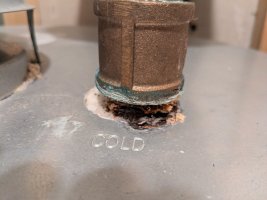
I stand corrected - you were right! The inlet connection is corroded and I can feel the insulation around it is wet. That must have seeped down via the insulation inside the outer metal cover and then leaked out from those two openings on the side. I'm hoping that a plumber will be able to replace the nipple. I have neither the tools nor the hand strength to remove the old one.
 

Attachments

  • PXL_20250821_165331091.jpg
    PXL_20250821_165331091.jpg
    69.7 KB · Views: 192
Check the fittings on top of the water heater, water connections. Quite often they will leak at the top, water flex or union, depending on where you are and local codes. A leak on the top will seap down and leave these types of deposits.
I preveiously said that I didn't think that this could be the case, but I stand corrected - you were right! See my post with a picture of the inlet connection.
 
I stand corrected - you were right! The inlet connection is corroded and I can feel the insulation around it is wet. That must have seeped down via the insulation inside the outer metal cover and then leaked out from those two openings on the side. I'm hoping that a plumber will be able to replace the nipple. I have neither the tools nor the hand strength to remove the old one.
And now I get to correct myself again! As it turns out I do have the tools and the hand strength to remove the old nipple. I had a plumber come and tell me that the nipple could not be removed, and that I would need to spend several thousand dollars for a new water heater. So I figured I had nothing to lose. Last night I sprayed the connection between the nipple and the tank with penetrating oil. Then, this morning I pulled out an old Rigid brand 14 inch pipe wrench that used to belong to my father (I don't think I've ever used this wrench before, and I've had it since 1989). The nipple didn't budge, so I used a hammer and banged on the handle until the wrench started to move. After that everything was pretty easy, and I'm a couple of thousand dollars ahead.

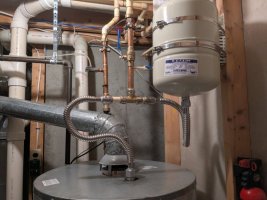
I attached a photo of the finished project. For those who object to Sharkbite fittings, I'm sorry but I'm a retired Chief Information Officer, not a plumber. I took the opportunity while changing the nipple and dip tube to also mount the expansion tank to a bracket secured to the wall stud. Previously it was mounted horizontally with no addional support to a brass tee just above the nipple.
 

Attachments

  • PXL_20250902_173743353.jpg
    PXL_20250902_173743353.jpg
    88.7 KB · Views: 165
Last edited:
Not a sharkbit fan, at all. At least yours are accessible if they blow or leak. I see nothing wrong with your install.

Correction, where is the pipe insulation? Cold and hot lines need some love.

Change your hot water tank anode next if you are feeling froggy.
 
Not a sharkbit fan, at all. At least yours are accessible if they blow or leak. I see nothing wrong with your install.

Correction, where is the pipe insulation? Cold and hot lines need some love.

Change your hot water tank anode next if you are feeling froggy.
I've been using Sharkbite fittings for about 15 years on my DIY plumbing projects at 3 different houses on copper, CPVC and pex. Only once has one leaked, and it leaked as soon as I turned the water back on due to my installation error. It was a stop valve for a toilet, and I failed to push the fitting all the way onto the pipe. Once I removed it, marked the depth more clearly and fitted it,to the new mark, it was fine. I've never installed one in an inaccessible spot, but that's because I've never had to install any fittings inside a wall. I beleve that if you prepare the pipe properly and make sure that you push the fitting in to the required depth, Sharkbites are not going to fail sooner than any other fitting. In the case of my water heater, the fitting that failed was a threaded brass couping connected to the nipple.
With all that said, if I were working with copper and was adept at soldering, I would most likely have gone that route and saved a few bucks, because Sharkbite fittings are not cheap.
 
Last edited:
Back
Top