
PEX and hotwater heater

David Oetinger

New Member
Messages
2
Reaction score
0
Points
0
Location
Kentucky
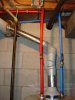
PEXatHWHeater.jpg I recently had my 2 story w/basement house piped by a licensed plumber. He used PEX throughout. Everything seems good. I sent some pics to my son and he tells me that the connections to the gas hotwater heater should have 18" copper rather than the direct connection shown in the attachment. Should I have him change the connections?
Thanks!
 
Last edited:
Besides the pex (it does need to be 18") where is the expansion tank and the vacuum breaker? Are you sure this "plumber" has a license? Oh and the connection to the smoke pipe is not legal either. WTF? do you live in Hackville ? Call my buddy Dunbar, he will straighten you out.
 
Pex

Yes, and unless you have a closed system you do not NEED an expansion tank. You also do not NEED a vacuum breaker on the heater, although a water heater in a second floor attic sometimes could use one, but NEVER one in a basement. The NEXT vacuum breaker I install on a water heater will be the FIRST one in 60 years, other than on solar heater panels.
 
504.1 Antisiphon devices. An approved means, such as a cold
water "dip" tube with a hole at the top or a vacuum relief valve
installed in the cold water supply line above the top of the heater
or tank, shall be provided to prevent siphoning of any storage
water heater or tank.

I would be willing to bet that that old tank does not have such a device.

Nowhere in the code does it say anything about a "closed system" The code says that you need an expansion tank if you have a water heater, any water heater, tank type or instantaneous. It does not say that if you have a well tank, you don't need an expansion tank. It does not say if you don't have a BFP you don't need one either. The 06 IPC requires the tank regardless.
 
Yes, and unless you have a closed system you do not NEED an expansion tank. You also do not NEED a vacuum breaker on the heater, although a water heater in a second floor attic sometimes could use one, but NEVER one in a basement. The NEXT vacuum breaker I install on a water heater will be the FIRST one in 60 years, other than on solar heater panels.

How do you figure that?

Half of the time you're preaching code, the other half of the time you're say what works and what doesn't...
 
Yes, and unless you have a closed system you do not NEED an expansion tank. You also do not NEED a vacuum breaker on the heater, although a water heater in a second floor attic sometimes could use one, but NEVER one in a basement. The NEXT vacuum breaker I install on a water heater will be the FIRST one in 60 years, other than on solar heater panels.

Ummmm really? A tank needs a vacuum break regardless. The idea of a vacuum break is to stop siphoning. Not because the water shouldn't be going back into the main but because you don't want your tank siphoned dry through a vacuum. Because if this happens your tank is gonna look like a crush pop can because of the atmospheric pressure crushing it.

I know Canadian code requires one on all installations.

ALWAYS install a vacuum break folks. ESPECIALLY if your tank is above the city water main (which most are).
 
expansion tank

What is an expansion tank and how would it be used in this instance?
 
Expansion tanks are used for the expansion that occurs in water when it's heated. If you have an "open" system that means that you have no plumbing devices such as Pressure Reducing Valves or Check valves that would not allow the expanded water to escape back through your water meter out into the water main in the street. If you have a "closed" system, one that has a PRV or a Check valve, then the water cannot go back through the meter and will result in a pressure increase. This sometimes results in your Temperature and Pressure valve (t+p) on your hot water tank to start draining because it's trying to relieve the pressure increase or can cause fittings to break. The expansion tank absorbs this pressure.
 
We don't require expansion tanks on open systems. Most water heater replacement guys will put one on regardless. What we've seen is that our meters will read when water is coming through the meter AND going out. With an expansion tank on an open system this water can be going in and out all day 24 hours and results in HUGE water bills. We require proof that a test has been performed that shows a closed system for an expansion tank. We also don't require Vac. breaks on upright tanks. The only time we require them is on a side inlet/outlet tank installed above the lowest fixture in a house or building since the side inlets don't have the port on the fill tube.
 
We don't require expansion tanks on open systems. Most water heater replacement guys will put one on regardless. What we've seen is that our meters will read when water is coming through the meter AND going out. With an expansion tank on an open system this water can be going in and out all day 24 hours and results in HUGE water bills. We require proof that a test has been performed that shows a closed system for an expansion tank. We also don't require Vac. breaks on upright tanks. The only time we require them is on a side inlet/outlet tank installed above the lowest fixture in a house or building since the side inlets don't have the port on the fill tube.

Are those local amendments to the code? Because nowhere in the IPC or the UPC does it make an exception for open or closed systems. besides that, although most top fed water heaters do have a small hole in the dip tube that handles vacuum relief, unless I can either see it before the heater is installed, or the instructions or diagram point the feature out, I will not accept the installation. It ain't my job to go on line or where ever to investigate every make and model of water heater to verify this feature. It's up to the installer to provide the information to me.
 
siphon

ALL dip tubes, even in the 50's, have an antisiphon opening in them. The vacuum relief valve is only beneficial if the heater is elevated to the point where enough negative pressure could be produced to collapse the tank, but this would be a different scenario than a typical water heater siphonage. In that situation the dip tube opening would be ineffective unless a faucet were opened at the same time. OUR code does not specify, not require, a vacuum relief valve, although it does require the dip tube opening which all heaters have as a matter of course. There are situations where "what works" and "what is code" conflict, and when that happens an intelligent plumber working with an intelligent inspector, (I know that is almost an oxymoron but there are a couple out there), will come to an agreement.
 
I agree 100% with the premise, however, for liability reasons, exceptions set a dangerous precedent unless they are documented and approved.
 
Back
Top